
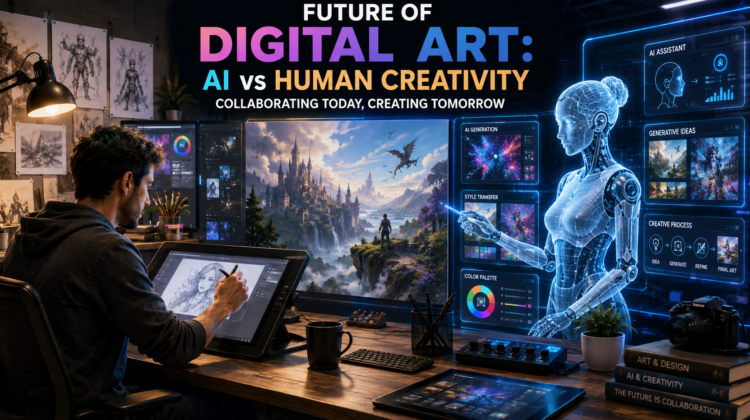
The world of digital art is experiencing one of the most significant transformations in its history. Just a few years ago, creating stunning digital illustrations, animations, or concept art required years of practice and mastery of professional software. Today, artificial intelligence can generate breathtaking visuals in seconds from a simple text prompt. This technological leap has sparked excitement, curiosity, and intense debate across the creative industry.
Some artists see AI as an extraordinary creative partner that speeds up workflows and opens new artistic possibilities. Others worry that machines could diminish the value of human creativity or replace traditional artistic careers altogether. Meanwhile, businesses, marketers, game developers, publishers, and content creators are embracing AI-powered design tools to produce visual content faster than ever before.
The conversation is no longer about whether AI will influence digital art—it already has. The real question is how artists and technology will coexist in the years ahead.
As we move through 2026, the future of digital art appears less like a battle between AI and humans and more like a collaboration that combines the strengths of both. Understanding this evolving relationship is essential for artists, designers, businesses, and anyone passionate about creativity.
1. The Rise of AI in Digital Art
Artificial intelligence has rapidly become one of the most powerful creative technologies available.
Modern AI image generators can create illustrations, concept art, product mockups, marketing graphics, fantasy landscapes, architectural visualizations, and photorealistic portraits within moments.
What once required several hours of sketching, rendering, and editing can now be generated in minutes.
This speed has transformed industries such as advertising, publishing, gaming, fashion, education, and digital marketing, where visual content is produced at an unprecedented scale.
AI Expands Creative Possibilities
Rather than limiting imagination, AI gives artists the ability to experiment with countless ideas before committing to a final design.
2. Human Creativity Still Defines Great Art
Despite impressive technological progress, human creativity remains the foundation of meaningful artistic expression.
Great art is more than technical perfection. It reflects emotion, personal experiences, cultural understanding, storytelling, and original ideas developed through years of observation and practice.
An artist creates with intention.
Every color choice, composition, texture, and visual detail often carries meaning beyond what appears on the surface.
AI can imitate artistic styles, but it cannot genuinely experience joy, sadness, hope, nostalgia, or personal growth.
These uniquely human qualities continue to define truly memorable artwork.
3. AI Is Becoming a Creative Assistant
Many professional artists no longer view artificial intelligence as competition.
Instead, they use AI to accelerate brainstorming, generate reference images, test different compositions, create mood boards, refine concepts, and automate repetitive editing tasks.
This allows creators to spend more time developing ideas and less time performing technical work.
Faster Workflows Without Losing Artistic Control
Artists remain responsible for creative direction while AI handles time-consuming production tasks.
The final vision still belongs to the human creator.
4. Digital Artists Are Adapting to New Tools
History shows that artists have always embraced technological innovation.
Photography changed painting.
Digital tablets transformed illustration.
Graphic software revolutionized publishing.
Now artificial intelligence represents the next stage of creative evolution.
Successful digital artists in 2026 are learning prompt engineering, AI-assisted editing, advanced compositing, and hybrid creative workflows that combine traditional artistic skills with intelligent automation.
Adaptability has become one of the industry’s most valuable skills.
5. AI Is Creating New Career Opportunities
While some traditional creative roles may evolve, entirely new career paths are emerging.
Professionals now specialize in AI art direction, prompt design, AI-assisted illustration, digital asset creation, creative automation consulting, AI workflow management, virtual production, and synthetic media development.
Businesses increasingly seek professionals who understand both artistic principles and AI technology.
Rather than reducing opportunities, AI is expanding the creative economy in unexpected ways.
6. Copyright and Ownership Remain Major Discussions
One of the biggest challenges surrounding AI-generated artwork involves intellectual property.
Questions continue regarding training data, artist consent, licensing, originality, ownership rights, and commercial usage.
Governments, technology companies, publishers, and creative organizations are working to establish clearer legal frameworks for AI-generated content.
Responsible creators increasingly prioritize transparency, proper licensing, and ethical AI usage to maintain trust within the creative community.
These conversations will continue shaping the future of digital art throughout the coming decade.
7. Businesses Are Using AI to Scale Visual Content
Modern businesses require an enormous amount of visual content.
Social media campaigns, advertisements, websites, product pages, presentations, educational materials, and marketing assets all depend on compelling graphics.
AI enables companies to produce visuals faster while reducing production costs.
However, brands that want to build strong emotional connections still rely on experienced designers to ensure consistency, storytelling, originality, and authentic brand identity.
Technology accelerates production, but human creativity strengthens communication.
8. Collaboration Will Define the Future of Art
Perhaps the most exciting development is the growing collaboration between humans and AI.
Instead of replacing artists, AI increasingly functions as an intelligent creative partner.
Artists provide imagination, emotion, storytelling, cultural awareness, ethics, and aesthetic judgment.
Artificial intelligence contributes speed, automation, experimentation, and technical assistance.
Together, they create possibilities that neither could achieve independently.
This collaborative model is becoming the new standard across creative industries.
9. Audiences Still Value Authentic Human Stories
Despite remarkable advances in AI-generated imagery, audiences continue seeking authentic human expression.
People connect emotionally with artwork because it reflects lived experiences, personal struggles, cultural traditions, and individual perspectives.
Whether viewing digital paintings, animated films, graphic novels, or illustrations, viewers appreciate originality and emotional depth.
Technology may generate images quickly, but meaningful storytelling remains a uniquely human strength.
This emotional connection ensures artists will continue playing a central role in creative industries.
10. The Future Is About Balance, Not Competition
The debate surrounding AI versus human creativity often suggests one must replace the other.
Reality tells a different story.
Artificial intelligence excels at automation, rapid experimentation, and technical assistance.
Human artists excel at imagination, emotional expression, innovation, ethical decision-making, and cultural interpretation.
The future of digital art lies in balancing these complementary strengths.
Creators who embrace both traditional artistic principles and modern AI tools will likely lead the next generation of digital innovation.
Looking Ahead: A New Creative Era
Artificial intelligence has permanently changed digital art, but it has not diminished the importance of human creativity. Instead, it has expanded what artists can accomplish while making powerful creative tools accessible to millions of people around the world.
As AI technology continues evolving beyond 2026, artists who combine technical expertise with originality, storytelling, empathy, and ethical responsibility will remain highly valued across industries.
The future of digital art is not a contest between machines and humans. It is a creative partnership where technology removes limitations while human imagination continues to inspire, innovate, and give meaning to every masterpiece.
For artists, designers, businesses, and creative professionals, the greatest opportunity lies not in choosing between AI and human creativity—but in learning how both can work together to shape the future of visual expression.
Leave a Reply