
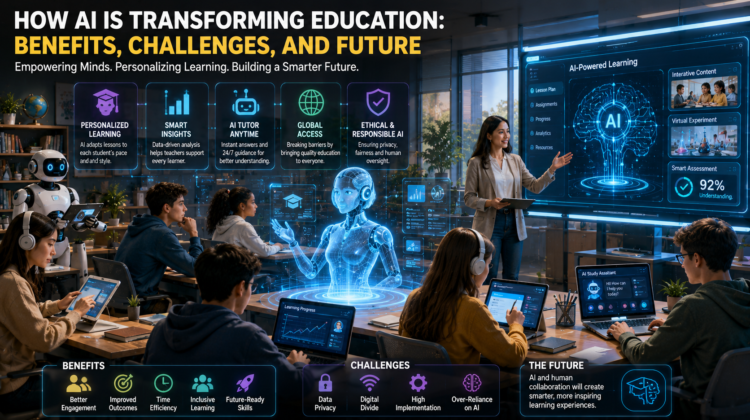
Education has always evolved with technology. From chalkboards to smart classrooms and from printed textbooks to digital learning platforms, every innovation has reshaped how knowledge is shared. Today, another revolutionary force is changing education faster than ever before—Artificial Intelligence (AI).
Students can now receive personalized tutoring from AI-powered assistants, teachers can automate repetitive administrative tasks, and educational institutions can analyze learning patterns to improve student outcomes. Whether someone is learning mathematics, coding, languages, science, or professional skills, AI is making education more accessible, interactive, and personalized than ever before.
However, this transformation also raises important questions. Can AI replace teachers? Will students become too dependent on technology? How can schools ensure ethical and responsible AI usage? These questions are becoming increasingly relevant as AI tools become part of everyday classrooms worldwide.
As we move through 2026 and look toward the future, artificial intelligence is not replacing education—it is redefining how learning happens. Understanding its benefits, challenges, and long-term impact is essential for educators, students, parents, and institutions alike.
1. AI Is Personalizing Learning for Every Student
One of AI’s greatest strengths is its ability to personalize education.
Traditional classrooms often teach every student at the same pace, even though each learner has different strengths, weaknesses, and learning styles.
AI-powered educational platforms analyze student performance in real time and adjust lessons accordingly. If a student struggles with algebra, the system provides additional explanations and practice exercises. If another learner masters a concept quickly, the platform introduces more advanced material.
Learning at an Individual Pace
This personalized approach helps students gain confidence while reducing frustration and improving overall learning outcomes.
Instead of one-size-fits-all education, AI supports truly individualized learning experiences.
2. AI Is Helping Teachers Focus on Teaching
Teachers spend countless hours grading assignments, preparing lesson plans, tracking attendance, and completing administrative work.
Artificial intelligence is reducing these repetitive tasks through automation.
AI can evaluate quizzes, organize classroom data, generate reports, identify struggling students, and even suggest lesson improvements based on classroom performance.
More Time for Meaningful Interaction
With administrative workloads reduced, teachers have more time to mentor students, encourage creativity, and build stronger classroom relationships.
Rather than replacing educators, AI allows them to focus on what matters most—teaching and inspiring learners.
3. Smart Tutoring Systems Are Available Anytime
Not every student has access to private tutors.
AI-powered tutoring platforms are helping bridge this gap by providing instant academic support around the clock.
Students can ask questions, receive explanations, practice problems, and revisit difficult topics whenever they need assistance.
Whether studying late at night or preparing for exams during weekends, learners always have access to educational guidance.
This flexibility makes education more accessible for millions of students around the world.
4. AI Makes Learning More Interactive
Modern students learn best when education is engaging.
Artificial intelligence is making classrooms more dynamic through simulations, virtual laboratories, educational games, augmented reality, and intelligent learning assistants.
Medical students can practice surgical procedures in virtual environments.
Engineering students can experiment with digital prototypes.
Language learners can engage in realistic AI-powered conversations.
Interactive experiences improve understanding while making learning enjoyable.
5. Data Analytics Helps Improve Student Success
Educational institutions generate enormous amounts of learning data.
AI analyzes attendance, assessment results, participation, assignment completion, and engagement patterns to identify students who may require additional support.
Instead of waiting until final examinations reveal problems, teachers receive early insights that help them intervene before students fall behind.
This proactive approach significantly improves academic performance and student retention.
6. AI Supports Inclusive Education
Artificial intelligence is helping create more accessible classrooms for learners with diverse needs.
Speech recognition assists students with physical disabilities.
Real-time translation supports multilingual classrooms.
Text-to-speech and speech-to-text technologies help learners with reading or writing challenges.
Adaptive learning platforms accommodate different cognitive abilities, allowing more students to participate successfully in education.
As AI technologies continue improving, education becomes increasingly inclusive and equitable.
7. Challenges of AI in Education
Despite its many advantages, artificial intelligence also introduces significant challenges.
Privacy concerns remain one of the biggest issues.
Educational systems collect large amounts of personal and academic information, requiring strong cybersecurity and responsible data management.
There is also growing concern that excessive dependence on AI could reduce critical thinking, creativity, and independent problem-solving if students rely too heavily on automated answers.
Educational institutions must carefully balance technology with traditional learning methods.
Ethical AI Usage Matters
Schools should establish clear guidelines regarding responsible AI use, academic honesty, transparency, and digital literacy.
Students must learn not only how to use AI but also when its use is appropriate.
8. Teachers Will Continue Playing a Central Role
One common misconception is that AI will replace teachers.
In reality, effective education depends on human qualities that technology cannot replicate.
Teachers provide emotional support, mentorship, motivation, empathy, ethical guidance, classroom leadership, and personalized encouragement.
Artificial intelligence processes information efficiently, but it cannot build meaningful human relationships or fully understand emotional learning needs.
The future classroom combines intelligent technology with experienced educators working together.
9. Lifelong Learning Is Becoming More Important
The rapid evolution of AI means professional skills become outdated more quickly than ever before.
As industries continue adopting automation, workers increasingly need continuous education to remain competitive.
AI-powered learning platforms make lifelong learning more accessible through personalized online courses, professional certifications, and adaptive training programs.
Individuals can continuously update their skills without returning to traditional classrooms.
This flexibility supports career growth throughout every stage of professional life.
10. The Future of AI in Education
Looking ahead, artificial intelligence will continue transforming nearly every aspect of education.
Future classrooms may include intelligent virtual teaching assistants, immersive virtual reality lessons, real-time language translation, AI-generated learning materials, predictive academic guidance, and highly personalized educational pathways.
Students may receive customized learning experiences that adapt continuously to their progress, interests, and career goals.
Educational institutions will increasingly integrate AI into curriculum design, assessment methods, and student support services.
Rather than replacing traditional education, AI will expand opportunities for learners everywhere.
Looking Ahead: Building Smarter Learning Environments
Artificial intelligence represents one of the most significant educational innovations of the modern era.
Its ability to personalize learning, automate administrative work, improve accessibility, support teachers, and provide continuous educational assistance is already transforming classrooms worldwide.
However, technology alone cannot create outstanding education.
The future depends on balancing AI-powered efficiency with human creativity, empathy, ethical responsibility, and meaningful teacher-student relationships.
Schools, universities, policymakers, and technology companies must work together to ensure AI remains a tool that enhances learning rather than replacing the human elements that make education truly valuable.
As AI continues evolving beyond 2026, students will gain greater access to personalized knowledge, teachers will receive more intelligent support, and educational institutions will become increasingly capable of preparing learners for an AI-driven world.
The classroom of tomorrow will not belong solely to machines or humans. It will thrive through collaboration between innovative technology and passionate educators working together to unlock every student’s potential.
Leave a Reply