
The workplace is changing faster than ever before. Artificial Intelligence is automating routine tasks, remote work has become a permanent reality for many industries, and companies are searching for professionals who can adapt to rapidly evolving technologies. The degree you earned a few years ago may still matter, but in 2026, your skills matter even more.
Employers are no longer hiring based solely on academic qualifications. They want candidates who can solve problems, embrace new technologies, communicate effectively, and continue learning throughout their careers. Whether you’re a student planning your future, a working professional looking for a promotion, or someone considering a career change, learning the right skills today can significantly improve your opportunities tomorrow.
The good news is that many of the most valuable skills can now be learned online through affordable courses, AI-powered learning platforms, and practical projects. What matters most is choosing skills that remain relevant as technology continues transforming industries.
In this guide, we’ll explore the top in-demand skills to learn in 2026, why they matter, and how they can help you build a future-proof career in an increasingly competitive job market.
1. Artificial Intelligence and Prompt Engineering
Artificial Intelligence has become one of the biggest workplace transformations of this decade.
Companies across healthcare, finance, education, manufacturing, retail, and marketing are integrating AI into daily operations. As a result, professionals who understand how to work with AI tools are becoming highly valuable.
Prompt engineering, the ability to communicate effectively with AI systems, has emerged as an essential workplace skill. Knowing how to write detailed prompts helps generate better reports, marketing campaigns, coding assistance, business insights, and creative content.
AI Literacy Is Becoming a Basic Workplace Skill
Just as computer literacy became essential years ago, AI literacy is quickly becoming a standard expectation across industries.
Professionals who understand AI will enjoy greater productivity and stronger career opportunities.
2. Data Analysis and Data Literacy
Modern businesses generate enormous amounts of information every day.
However, raw data only becomes valuable when someone can interpret it and turn it into actionable decisions.
Learning data analysis helps professionals understand customer behavior, identify business trends, measure performance, and improve decision-making.
Even non-technical careers increasingly require basic knowledge of spreadsheets, dashboards, visualization tools, and business intelligence platforms.
Data-driven thinking is becoming one of the most valuable professional skills worldwide.
3. Cybersecurity Knowledge
As businesses become more digital, cyber threats continue increasing.
Organizations of every size need professionals who understand digital security, privacy protection, and safe online practices.
Even employees outside dedicated cybersecurity roles benefit from understanding password management, phishing prevention, secure communication, and responsible handling of sensitive information.
Security Awareness Benefits Every Career
Cybersecurity is no longer limited to IT departments.
Every professional handling digital information plays a role in protecting organizations from security risks.
4. Cloud Computing Skills
Cloud technology powers modern businesses.
From startups to multinational corporations, organizations rely on cloud platforms for storage, software, collaboration, and application development.
Professionals with cloud computing knowledge understand how businesses operate more efficiently while reducing infrastructure costs.
Cloud skills remain among the fastest-growing technical competencies in 2026.
5. Digital Marketing and Content Strategy
Businesses increasingly compete online.
As a result, professionals who understand search engine optimization, content marketing, email marketing, paid advertising, analytics, and social media strategy remain in extremely high demand.
AI has automated many marketing tasks, but strategic thinking, audience understanding, storytelling, and campaign planning continue requiring human expertise.
Digital marketing combines creativity with measurable business results.
6. Software Development and Low-Code Programming
Technology continues creating demand for software developers.
At the same time, low-code and no-code platforms allow professionals without advanced programming backgrounds to build applications, automate workflows, and improve business operations.
Learning basic programming alongside AI-assisted development tools significantly expands career opportunities across industries.
Coding Remains Highly Valuable
Although AI can generate code, skilled developers remain essential for designing systems, solving complex problems, testing applications, and ensuring software quality.
Programming continues evolving rather than disappearing.
7. Emotional Intelligence and Communication
Technology cannot replace genuine human relationships.
Strong communication, empathy, leadership, teamwork, negotiation, and emotional intelligence remain among the most valuable workplace skills.
Professionals who collaborate effectively, resolve conflicts, and inspire others often advance faster than those relying solely on technical expertise.
As automation increases, uniquely human skills become even more important.
8. Project Management and Organizational Skills
Organizations increasingly rely on professionals who can manage projects efficiently.
Project management includes planning, scheduling, budgeting, risk assessment, resource coordination, and team collaboration.
Whether working in technology, healthcare, education, finance, or manufacturing, effective project managers help businesses achieve strategic goals.
AI tools now simplify project tracking, but leadership and decision-making remain human responsibilities.
9. Financial Literacy and Business Understanding
Understanding money has become an essential life skill.
Financial literacy includes budgeting, investing, taxation, business economics, personal finance, and financial decision-making.
Professionals with business awareness understand how organizations generate revenue, manage expenses, evaluate investments, and create sustainable growth.
Regardless of career path, financial knowledge improves both personal and professional success.
10. Lifelong Learning and Adaptability
Perhaps the most important skill of all is the ability to continue learning.
Technology evolves rapidly.
New software, industries, regulations, and workplace expectations emerge every year.
Professionals who remain curious, flexible, and willing to acquire new knowledge consistently outperform those who resist change.
Adaptability Creates Long-Term Career Security
Future careers will belong to individuals who embrace continuous learning rather than relying on existing knowledge alone.
Learning itself has become one of the most valuable professional skills.
How to Choose the Right Skill for Your Career
Choosing which skill to learn depends on your career goals, interests, and industry.
Students entering the workforce may prioritize AI, programming, and digital marketing.
Business professionals might benefit more from leadership, project management, and financial literacy.
Creative professionals can combine AI tools with communication and content creation skills.
Rather than mastering everything simultaneously, focus on one valuable skill at a time and build practical experience through projects, certifications, internships, or freelance work.
Consistent improvement creates lasting professional advantages.
Final Thoughts
The job market of 2026 rewards individuals who combine technical expertise with human-centered skills.
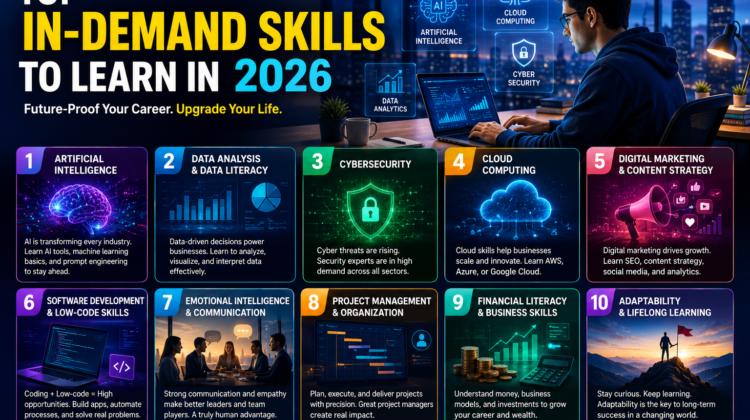
Artificial Intelligence, cloud computing, cybersecurity, digital marketing, data analysis, software development, emotional intelligence, project management, financial literacy, and adaptability are shaping the future of work across nearly every industry.
The most successful professionals are not necessarily those with the highest academic qualifications but those who continue learning, embrace innovation, and apply their knowledge to solve real-world problems.
Fortunately, today’s learning resources make skill development more accessible than ever before. Online courses, AI-powered tutors, professional certifications, and hands-on projects allow anyone to build valuable expertise regardless of age or background.
The future belongs to lifelong learners.
By investing in the right skills today, you prepare yourself for better career opportunities, greater financial security, and long-term professional success in an increasingly AI-driven world.
Leave a Reply