
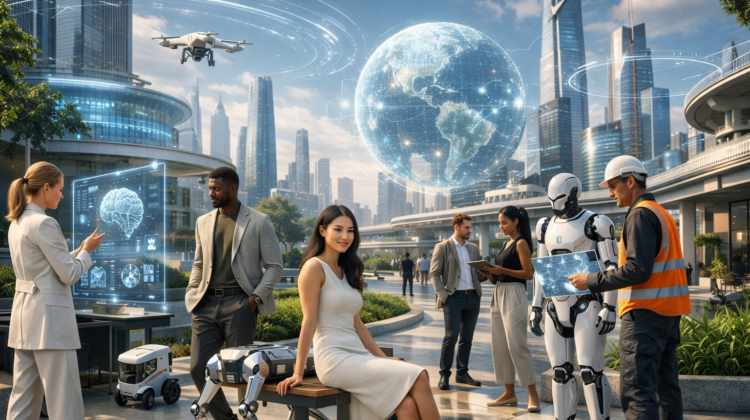
Introduction: A Year Where Technology Stops Evolving and Starts Transforming
2026 is shaping up to be one of those rare years in technology where change doesn’t just feel fast—it feels structural. It’s no longer about gadgets getting smarter or apps getting faster. Instead, entire industries are being rebuilt in real time. From artificial intelligence systems that can independently manage workflows to breakthroughs in quantum computing and biotechnology, the pace of innovation is reshaping how people work, live, and interact with the world.
What makes this moment especially interesting is that technology is no longer a separate “industry.” It has become the foundation of everything else. Healthcare, education, entertainment, finance, and even governance are being redesigned through digital intelligence. And in 2026, these shifts are not theoretical anymore—they are visible in everyday life.
The biggest technology news of 2026 reflects a world where machines don’t just assist humans, they collaborate with them. It’s a world where intelligence is distributed across systems, devices, and environments. And more importantly, it’s a world where innovation is no longer limited to big tech companies—startups, governments, and even individuals are shaping the future.
Artificial Intelligence Becomes Truly Autonomous
If 2023 to 2025 was about generative AI becoming mainstream, 2026 is the year AI becomes autonomous in a meaningful way. The latest AI systems are no longer limited to responding to prompts. They are now capable of planning, executing, and refining multi-step tasks with minimal supervision.
Businesses are increasingly adopting what are now called “AI agents,” systems that can manage entire operations such as customer support, marketing campaigns, data analysis, and even product development cycles. Instead of using multiple tools, companies are deploying single AI ecosystems that coordinate everything.
What makes this shift powerful is the integration of real-time learning. These systems adapt continuously based on outcomes, which means they improve without constant human intervention. In industries like e-commerce and finance, AI is already handling complex decision-making processes that once required large teams.
In 2026, the conversation is no longer about whether AI will replace jobs, but how humans and AI will collaborate as co-workers in hybrid digital environments.
Quantum Computing Moves Closer to Real-World Use
Quantum computing has been discussed for years, often feeling distant from practical reality. But 2026 marks a turning point where quantum systems begin solving problems that traditional computers struggle with.
Major breakthroughs in stability and error correction have allowed quantum processors to handle more meaningful workloads. While we are still in the early stages, industries like pharmaceuticals, logistics, and cybersecurity are already testing quantum-powered models.
One of the most impactful developments is in drug discovery. Simulations that once took years can now be processed in days by quantum-enhanced systems. Similarly, financial institutions are exploring quantum algorithms for risk analysis and fraud detection at scales previously unimaginable.
Although quantum computing is not yet mainstream, 2026 is widely seen as the year it transitions from experimental labs into early commercial adoption.
The Expansion of AI-Powered Robotics
Robotics has entered a new phase in 2026, driven by advances in AI vision systems and real-time decision-making models. Robots are no longer confined to factories or controlled environments. They are now being deployed in hospitals, retail stores, warehouses, and even homes.
In healthcare, robotic assistants are helping surgeons perform precision tasks with enhanced accuracy. In logistics, autonomous robots are managing inventory, sorting packages, and optimizing warehouse operations without human supervision.
What has changed dramatically is adaptability. Modern robots can now learn from their surroundings and adjust their behavior dynamically. This makes them far more useful in unpredictable environments compared to earlier generations of rigid automation systems.
This evolution is pushing society closer to a world where robotics becomes part of everyday infrastructure rather than a specialized tool.
The Rise of Spatial Computing and Mixed Reality
Spatial computing is one of the most exciting technological shifts of 2026. It blends augmented reality, virtual reality, and real-world environments into seamless digital experiences. Instead of looking at screens, users are now interacting with information layered directly into their physical surroundings.
Workplaces are beginning to adopt mixed reality systems for collaboration. Teams spread across continents can now meet in shared virtual environments that feel physically present. Engineers can manipulate 3D models in real time, and designers can build products in immersive digital spaces before anything is physically manufactured.
In education, spatial computing is transforming learning experiences. Students can explore historical events, biological systems, or architectural structures in fully interactive environments.
This shift represents a fundamental change in how humans interact with digital information—not through devices, but through space itself.
Breakthroughs in Biotechnology and AI-Driven Medicine
Healthcare innovation in 2026 is being driven heavily by AI and biotechnology convergence. One of the biggest breakthroughs is the use of AI in personalized medicine, where treatments are tailored based on a patient’s genetic profile, lifestyle, and real-time health data.
Wearable devices have also become significantly more advanced. Instead of simply tracking steps or heart rate, they now continuously monitor metabolic signals, stress levels, and early indicators of disease. These devices are integrated with AI systems that can predict health risks before symptoms even appear.
Gene-editing technologies are also advancing rapidly. While still under strict regulation, research in targeted therapies is showing promising results for previously untreatable conditions.
Healthcare in 2026 is shifting from reactive treatment to predictive prevention, powered by continuous data intelligence.
Next-Generation Connectivity: Beyond 5G
While 5G is still expanding globally, 2026 is already seeing early development of 6G research networks. These next-generation systems aim to deliver near-zero latency and ultra-high-speed connectivity that can support immersive technologies, autonomous vehicles, and global-scale IoT systems.
One of the most significant impacts of advanced connectivity is the rise of fully synchronized digital ecosystems. Smart cities are becoming more efficient as traffic systems, energy grids, and public services communicate in real time.
In rural regions, improved connectivity is also helping bridge the digital divide, allowing access to education, healthcare, and financial systems that were previously limited.
Connectivity is no longer just about speed—it is about enabling intelligence across entire environments.
Cybersecurity in the Age of Intelligent Threats
As technology evolves, so do cyber threats. In 2026, cybersecurity has become one of the most critical areas of innovation. The rise of AI-driven attacks means that traditional security systems are no longer sufficient.
In response, organizations are deploying AI-based defense systems that can detect anomalies in real time and respond instantly to threats. These systems analyze behavioral patterns instead of relying solely on predefined rules.
Another major development is decentralized identity verification, which reduces reliance on centralized databases that are vulnerable to breaches. Blockchain-based authentication systems are also gaining traction in securing sensitive transactions.
Cybersecurity in 2026 is no longer reactive. It is predictive, adaptive, and continuously evolving.
Green Technology and the Push for Sustainable Innovation
Sustainability is now a core driver of technological innovation. In 2026, green technology is not just an ethical choice but an economic necessity.
Renewable energy systems are becoming more efficient through AI-driven energy management. Smart grids are optimizing electricity distribution in real time, reducing waste and improving efficiency.
Electric vehicles continue to evolve, with faster charging systems and improved battery life. Research into alternative energy storage solutions is also accelerating, aiming to reduce dependency on traditional lithium-based systems.
Even data centers, which power the digital world, are being redesigned to reduce environmental impact through advanced cooling systems and renewable energy integration.
Technology in 2026 is increasingly defined not just by performance, but by sustainability.
Conclusion: A Future That Is Already Here
The biggest technology innovations of 2026 show a world that is no longer waiting for the future—it is actively building it. Artificial intelligence, quantum computing, biotechnology, robotics, and spatial computing are not isolated trends. They are interconnected systems reshaping how civilization functions.
What stands out most is not just the speed of innovation, but its depth. Technology is no longer adding convenience to life; it is redefining the structure of industries, economies, and human interaction itself.
As 2026 unfolds, one thing is clear: the boundary between the digital and physical world is disappearing faster than ever before, and the next phase of innovation will be defined by how seamlessly both worlds merge.
Leave a Reply