
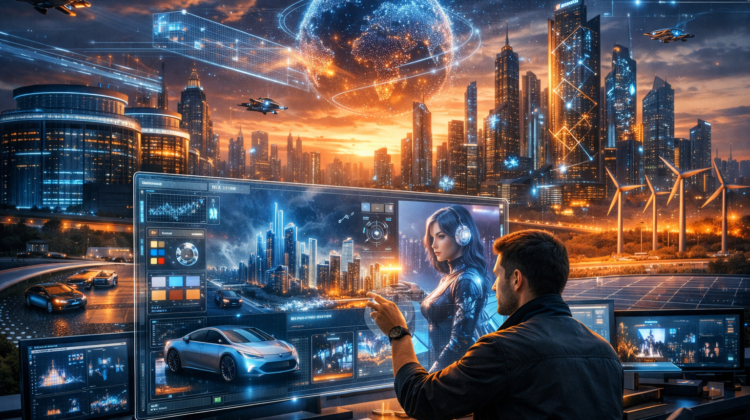
Introduction: The Future Is Not Coming—It Is Already Here
There was a time when the “future” felt distant, something we only saw in science fiction movies or futuristic concept videos. But in 2026, that future has quietly arrived and settled into our everyday lives without asking for attention. From the moment we unlock our smartphones with facial recognition to the way AI recommends what we watch, read, or buy, emerging technologies are already shaping how we live, work, and think.
What makes this transformation even more powerful is how normal it all feels. Artificial intelligence, virtual reality, blockchain systems, and advanced computing are no longer experimental ideas locked inside research labs. They are practical tools influencing industries, redefining creativity, and reshaping global economies in real time.
The real question is no longer whether technology will change the world—it already has. The real story is how deeply these innovations will continue to merge with human life and creativity in the coming years. And as we step further into this era, understanding these technologies is no longer optional—it is essential for staying relevant in a rapidly evolving world.
1. The Future Is Already Arriving Faster Than We Think
There was a time when “future technology” meant something far away, almost like science fiction you would see in movies. But in 2026, that future is no longer waiting ahead of us—it is quietly blending into our daily lives. From the way we work to how we create, communicate, and even think, emerging technologies are reshaping reality at a speed most people are still trying to catch up with.
Think about your everyday routine. You unlock your phone using facial recognition, ask an AI assistant to summarize information, and rely on algorithms to decide what you watch or buy next. None of this feels unusual anymore. That is exactly the point—the most powerful technologies are the ones we stop noticing because they become part of life itself.
The real shift happening today is not just technological advancement, but deep integration. Technologies are no longer standalone tools; they are ecosystems that influence industries, economies, and human behavior simultaneously. And at the center of this transformation are a few groundbreaking innovations that are quietly rewriting the rules of the future.
2. Artificial Intelligence Moving Beyond Automation Into Intelligence
Artificial Intelligence is no longer limited to chatbots or simple automation tasks. It has evolved into something far more powerful—adaptive intelligence that learns, predicts, and even creates. In 2026, AI systems are deeply embedded in healthcare diagnostics, financial forecasting, customer experience, and creative industries.
What makes modern AI so transformative is its ability to understand context. Instead of just responding to commands, AI now interprets intent. This shift is allowing businesses to operate with unprecedented efficiency. For example, in healthcare, AI systems can analyze medical imaging in seconds and detect early signs of diseases that might take human specialists much longer to identify.
In creative industries, AI is becoming a collaborator rather than just a tool. Designers, writers, and marketers are now working alongside intelligent systems that suggest ideas, generate visuals, and even refine content in real time. This is not replacing creativity—it is amplifying it in ways we have never seen before.
As AI continues to evolve, the boundary between human intelligence and machine intelligence becomes less about competition and more about collaboration.
3. Quantum Computing Opening Doors to Impossible Problems
If AI is transforming how we think, quantum computing is transforming what we thought was impossible. Traditional computers process information in binary form, but quantum computers use quantum bits that can exist in multiple states at once. This allows them to solve problems that would take conventional machines thousands of years.
In 2026, quantum computing is still in its early stages, but its potential is enormous. Industries like pharmaceuticals, logistics, and cybersecurity are already experimenting with quantum-powered solutions. For instance, drug discovery processes that once took years can now be simulated in significantly shorter timeframes.
The most fascinating part of quantum computing is its unpredictability. It challenges our traditional understanding of logic and computation. While it is not yet mainstream, it is steadily moving from research labs into real-world applications, signaling a major shift in computational power over the next decade.
4. The Rise of Immersive Technologies Like AR and VR
Augmented Reality and Virtual Reality are no longer confined to gaming or entertainment. They are becoming essential tools in education, training, retail, and remote collaboration.
Imagine attending a business meeting where participants appear as holographic avatars in a shared virtual space. Or think about medical students practicing surgeries in a fully immersive simulation before ever entering an operating room. These experiences are no longer theoretical—they are actively being developed and deployed.
In retail, AR allows customers to visualize products in their homes before purchasing. In education, students can explore historical events or complex scientific models as interactive environments rather than static textbooks.
The future of immersive technology is not about escaping reality but enhancing it. It creates a blended world where digital and physical experiences coexist seamlessly.
5. Blockchain Evolving Beyond Cryptocurrency
Blockchain technology initially gained attention through cryptocurrencies, but its real power lies far beyond digital money. In 2026, blockchain is becoming a foundation for secure data sharing, transparent supply chains, and decentralized digital identities.
One of the most impactful uses of blockchain is in data security. As cyber threats become more sophisticated, decentralized systems offer a way to reduce single points of failure. This makes sensitive data more resilient against attacks.
In supply chain management, blockchain ensures transparency from production to delivery. Consumers can verify the origin of products, ensuring authenticity and ethical sourcing. This level of transparency is reshaping trust between businesses and consumers.
Blockchain is also enabling new forms of digital ownership, where individuals have more control over their personal data and digital assets than ever before.
6. Biotechnology and Human Enhancement Technologies
Biotechnology is another frontier that is rapidly evolving. Advances in gene editing, personalized medicine, and bioengineering are transforming healthcare and human longevity.
In 2026, personalized medicine is becoming more common, where treatments are tailored specifically to an individual’s genetic makeup. This increases effectiveness and reduces side effects significantly. Technologies like CRISPR are also opening discussions around gene editing, not just for disease prevention but potentially for enhancing human capabilities.
Wearable biotech devices are also becoming more advanced. They can monitor health in real time and predict potential medical issues before they become serious. This shift from reactive to proactive healthcare is one of the most important transformations in modern medicine.
7. Edge Computing and the Need for Real-Time Intelligence
As devices become smarter and more connected, the demand for faster processing has led to the rise of edge computing. Instead of sending data to centralized cloud servers, edge computing processes information closer to where it is generated.
This is especially important for applications like autonomous vehicles, smart cities, and industrial automation. When decisions need to be made in milliseconds, even a slight delay can have serious consequences.
Edge computing is making systems more efficient, responsive, and reliable. It is quietly becoming the backbone of modern digital infrastructure, supporting everything from smart homes to large-scale industrial networks.
8. How Emerging Technologies Are Transforming Creative Industries
While emerging technologies are reshaping industries like healthcare and finance, one of the most exciting transformations is happening in the creative world. Graphic design, in particular, is undergoing a revolution powered by artificial intelligence.
Design is no longer just about manual skill. It is becoming a hybrid process where human creativity is supported by intelligent tools that accelerate ideation, automate repetitive tasks, and expand artistic possibilities.
This shift is not reducing the role of designers. Instead, it is allowing them to focus more on conceptual thinking and storytelling while technology handles execution-heavy tasks.
9. Top AI Design Software for Graphic Designers in 2026
One of the most significant outcomes of AI advancement is the rise of intelligent design platforms that simplify complex creative workflows. These tools are changing how designers work, especially in fast-paced digital environments where speed and originality matter equally.
Adobe Firefly has become one of the most widely used AI design tools, integrating seamlessly into the Adobe ecosystem. It allows designers to generate images, textures, and design elements using simple text prompts, significantly reducing production time while maintaining professional quality.
Canva AI has also evolved beyond a simple design platform. It now offers intelligent layout suggestions, automated branding kits, and real-time content generation features that help even non-designers create professional-grade visuals.
Figma AI is transforming collaborative design workflows. Teams can now generate interface components, improve UX layouts, and test design variations faster than ever before. It bridges the gap between design thinking and execution in a highly interactive environment.
Midjourney continues to play a major role in conceptual and artistic exploration. Designers use it to generate visual ideas, mood boards, and artistic directions that serve as inspiration for larger projects. Its ability to interpret abstract prompts makes it especially powerful for creative brainstorming.
Runway ML is pushing the boundaries of AI-powered video and motion design. It allows creators to generate, edit, and enhance video content using AI, making high-quality production more accessible than ever before.
These tools collectively represent a new era where design is no longer limited by technical constraints. Instead, creativity is expanded by intelligent systems that act as partners in the creative process.
10 The Road Ahead Where Technology and Creativity Merge
The most important realization about emerging technologies is that they are not separate forces—they are interconnected. Artificial intelligence supports quantum computing research. Blockchain strengthens digital ecosystems. AR and VR redefine human interaction. And AI design tools transform how creativity is expressed.
As we move deeper into this technological era, the line between human ability and machine capability continues to blur. But rather than replacing human effort, these technologies are reshaping it into something more powerful and efficient.
The future is not about choosing between humans and machines. It is about learning how both can work together to build systems, ideas, and experiences that were once unimaginable.
The real question is no longer what technology will change next, but how ready we are to evolve with it.
Conclusion: A Future Built on Collaboration Between Humans and Technology
The journey of emerging technologies shows one clear direction—everything is moving toward integration, intelligence, and interconnection. Artificial intelligence is becoming more intuitive, quantum computing is pushing the boundaries of problem-solving, and immersive technologies like AR and VR are blending digital and physical realities in powerful new ways.
At the same time, blockchain is rebuilding trust in digital systems, biotechnology is redefining healthcare and human potential, and edge computing is making real-time intelligence a reality across industries. Together, these innovations are not just improving systems—they are redefining what systems even mean.
In the creative world, especially with the rise of AI design software, we are witnessing a major shift. Tools like Adobe Firefly, Figma AI, Canva AI, Midjourney, and Runway ML are not replacing designers but empowering them. Creativity is no longer limited by technical skill alone; it is now enhanced by intelligent collaboration between human imagination and machine precision.
As we move forward, the most successful individuals and organizations will not be those who resist change, but those who learn to adapt and evolve with it. Technology is not replacing human potential—it is expanding it in ways we are only beginning to understand.
The future belongs to those who can think creatively with machines, not against them.
Leave a Reply