
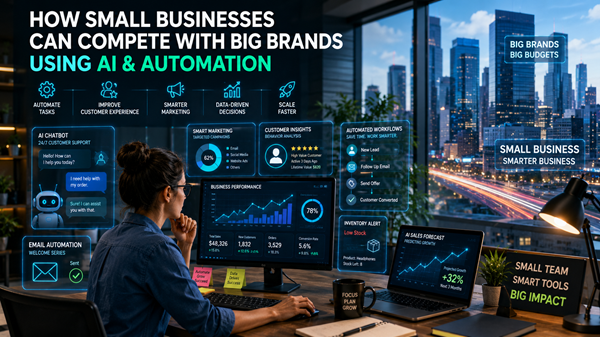
Running a small business has never been easy. Limited budgets, smaller teams, and fierce competition often make it seem impossible to compete with well-established brands that have millions to spend on marketing, technology, and customer service. For years, large corporations had a clear advantage because they could invest heavily in expensive software, data analytics, and automation systems that smaller companies simply couldn’t afford.
That reality is changing rapidly. In 2026, artificial intelligence and automation have become more accessible than ever, giving small businesses access to powerful tools once reserved for global enterprises. Today, a local retailer can use AI to personalize customer experiences, an online startup can automate marketing campaigns, and a family-owned business can provide round-the-clock customer support with intelligent chatbots—all without hiring a massive team or spending a fortune.
This shift is creating a more level playing field. Success is no longer determined solely by company size but by how effectively businesses use technology to improve efficiency, understand customers, and make smarter decisions.
If you’re a small business owner wondering how to compete with industry giants, AI and automation may be your greatest competitive advantage. Here’s how these technologies are helping small businesses grow faster, work smarter, and build stronger customer relationships in 2026.
1. AI Helps Small Businesses Deliver Personalized Customer Experiences
One of the biggest advantages large brands traditionally enjoyed was access to customer data and personalized marketing.
Today, AI-powered tools allow even the smallest businesses to analyze customer behavior, purchasing history, browsing activity, and preferences in real time.
Instead of sending identical promotions to every customer, businesses can create personalized recommendations, targeted email campaigns, and customized product suggestions that significantly improve engagement and sales.
Customers increasingly expect personalized experiences, and AI makes delivering them both affordable and efficient.
Why Personalization Matters
People are far more likely to buy from businesses that understand their preferences and provide relevant recommendations.
2. Automation Saves Time by Handling Repetitive Tasks
Small business owners often wear multiple hats.
They answer customer emails, process invoices, manage inventory, schedule appointments, create marketing campaigns, and monitor social media—all while trying to grow the business.
Automation eliminates many repetitive administrative tasks.
Scheduling software automatically books appointments, AI assistants answer routine customer questions, accounting systems organize financial records, and marketing platforms send follow-up emails without manual effort.
By reducing routine workloads, business owners gain more time to focus on innovation, strategy, and customer relationships.
3. AI Improves Customer Support Around the Clock
Consumers expect fast responses regardless of the time of day.
Hiring customer support teams to provide 24-hour service is often impossible for smaller businesses.
AI-powered chatbots and virtual assistants solve this challenge by answering common questions instantly, helping customers place orders, checking delivery status, recommending products, and directing complex issues to human representatives when necessary.
This improves customer satisfaction while reducing support costs.
In 2026, many consumers are comfortable interacting with intelligent virtual assistants for routine inquiries, making AI customer service a practical investment for businesses of every size.
4. Smarter Marketing Produces Better Results
Marketing budgets are often one of the biggest limitations for small businesses.
Artificial intelligence helps maximize every marketing dollar by identifying the most effective audiences, analyzing campaign performance, predicting customer interests, and recommending content strategies.
AI also assists with writing advertising copy, generating social media posts, optimizing email subject lines, creating visual content, and improving search engine optimization.
Rather than replacing creativity, AI enables small marketing teams to produce professional campaigns more efficiently.
Better Decisions Through Data
Instead of relying on guesswork, businesses can make informed marketing decisions based on customer behavior and performance analytics.
5. Sales Forecasting Becomes More Accurate
Knowing what customers will buy next is incredibly valuable.
Machine learning analyzes historical sales data, seasonal demand, purchasing trends, and market conditions to forecast future sales with greater accuracy.
These predictions help businesses optimize inventory, reduce waste, avoid stock shortages, and improve financial planning.
Even small improvements in forecasting can significantly increase profitability.
As AI forecasting tools become more affordable, they are increasingly accessible to businesses of all sizes.
6. AI Strengthens Online Shopping Experiences
E-commerce continues growing rapidly, making customer experience a major competitive advantage.
AI enhances online stores by recommending products, personalizing homepage content, optimizing pricing, identifying abandoned shopping carts, and improving search functionality.
Customers enjoy faster, more relevant shopping experiences while businesses increase conversion rates and average order values.
These capabilities were once available only to large online retailers but are now accessible through affordable AI-powered e-commerce platforms.
7. Automation Improves Financial Management
Managing business finances can consume valuable time.
AI-powered accounting software automatically categorizes expenses, generates financial reports, detects unusual transactions, predicts cash flow, and simplifies tax preparation.
Automation reduces human error while providing business owners with clearer financial insights.
Better financial visibility allows companies to make faster and more confident business decisions.
For growing businesses, this operational efficiency can become a significant competitive advantage.
8. AI Supports Smarter Hiring Decisions
Recruiting talented employees can be challenging for small businesses competing against larger employers.
Artificial intelligence assists by screening resumes, identifying qualified candidates, scheduling interviews, and analyzing hiring trends.
While final hiring decisions should always involve human judgment, AI reduces administrative work and accelerates recruitment processes.
Businesses can therefore focus more on evaluating candidate skills and cultural fit rather than sorting through hundreds of applications manually.
9. Data-Driven Decision Making Levels the Playing Field
Large corporations have long relied on sophisticated analytics to guide business strategy.
Today, AI-powered dashboards allow small businesses to monitor sales, customer behavior, website traffic, inventory performance, operational efficiency, and financial metrics in real time.
Instead of making decisions based solely on intuition, business owners gain actionable insights that support smarter planning and faster responses to changing market conditions.
Access to high-quality analytics is becoming one of the greatest equalizers in modern business.
10. AI Enables Small Businesses to Scale Faster
Growth often creates operational complexity.
As customer numbers increase, manual processes become increasingly difficult to manage.
Automation enables businesses to expand without proportionally increasing staffing costs.
Customer communications, inventory updates, order processing, appointment scheduling, reporting, and workflow management continue operating efficiently even as demand grows.
This scalability allows entrepreneurs to focus on innovation rather than administrative bottlenecks.
Businesses that successfully automate early are often better prepared for long-term expansion.
Why Human Creativity Still Matters
Artificial intelligence can process data, automate repetitive tasks, and generate valuable insights.
However, customers continue valuing authenticity, creativity, empathy, and personal relationships.
Successful small businesses combine AI efficiency with human expertise.
Business owners understand local communities, build meaningful customer relationships, create unique brand identities, and deliver personalized experiences that technology alone cannot replicate.
Rather than replacing entrepreneurs, AI empowers them to spend more time on the aspects of business that matter most.
Looking Ahead: The Future of Small Business Success
Artificial intelligence is no longer a luxury reserved for multinational corporations. In 2026, it has become an essential business tool that enables startups and small companies to compete on a much more equal footing.
As AI technology becomes increasingly affordable and user-friendly, small businesses will continue discovering new opportunities to automate operations, improve customer experiences, increase productivity, and make smarter decisions.
The businesses that succeed over the next decade will not necessarily be the ones with the largest budgets. Instead, they will be the organizations that embrace innovation, adapt quickly, and use AI strategically to deliver exceptional value to customers.
For entrepreneurs, this is an exciting moment. Technology has dramatically lowered traditional barriers to competition, creating unprecedented opportunities for small businesses to grow, innovate, and compete successfully against even the biggest brands.
Leave a Reply