
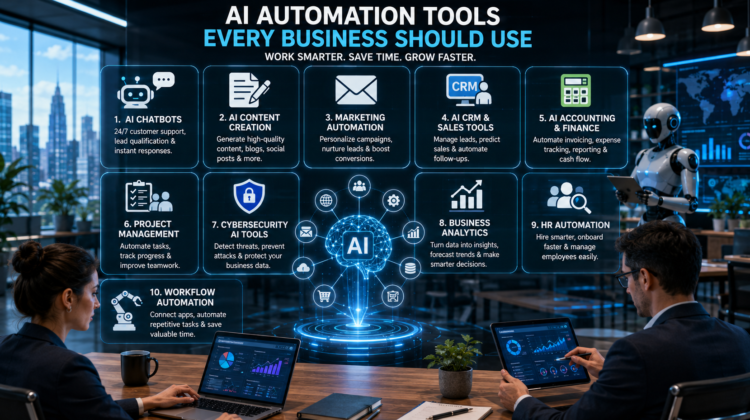
Running a successful business in 2026 is no longer just about working harder—it’s about working smarter. Whether you operate a startup, a growing e-commerce store, a local service company, or a large enterprise, one challenge remains the same: finding enough time to handle everything efficiently while keeping customers happy and staying ahead of competitors.
For years, businesses relied on manual processes for customer support, marketing, accounting, sales, scheduling, and data analysis. These repetitive tasks consumed valuable hours that could have been spent on innovation and strategic growth. Today, artificial intelligence and automation have completely changed that equation.
AI automation tools are helping businesses automate routine work, make faster decisions, improve customer experiences, and reduce operational costs. What was once considered expensive enterprise technology is now affordable and accessible to organizations of every size.
The businesses leading their industries are not necessarily those with the largest budgets. Instead, they are the ones using AI automation intelligently to increase productivity while allowing employees to focus on high-value work that requires creativity and human expertise.
If you’re looking to future-proof your business, here are the most valuable AI automation tools every organization should consider using in 2026.
1. AI Chatbots for Customer Support
Customer expectations have changed dramatically over the past few years.
People expect businesses to respond instantly, regardless of the time of day. Hiring customer service teams to provide round-the-clock support can be expensive, especially for small businesses.
AI chatbots solve this challenge by answering frequently asked questions, helping customers find products, tracking orders, scheduling appointments, and resolving common issues automatically.
Modern AI chatbots understand natural language, making conversations feel increasingly human while reducing support costs.
Why Businesses Need Them
Providing fast customer service improves customer satisfaction, increases retention, and allows human support teams to focus on more complex requests.
2. AI Content Creation Tools
Content marketing remains one of the most effective ways to attract customers.
However, producing blog articles, social media posts, product descriptions, email newsletters, advertising copy, and video scripts consistently requires significant time and effort.
AI writing assistants help businesses generate high-quality first drafts, brainstorm ideas, improve grammar, optimize SEO, and personalize marketing content.
Rather than replacing human creativity, these tools accelerate content production and improve consistency across marketing channels.
Businesses can therefore publish more frequently without dramatically increasing marketing costs.
3. AI Marketing Automation Platforms
Marketing automation has become essential for modern businesses.
AI-powered platforms analyze customer behavior, segment audiences, personalize email campaigns, optimize advertising budgets, predict customer interests, and automatically schedule communications.
Instead of manually sending promotions, businesses can deliver highly targeted messages based on customer preferences and buying behavior.
This results in stronger engagement, higher conversion rates, and improved return on marketing investment.
Smarter Campaign Optimization
Artificial intelligence continuously learns from campaign performance, helping businesses improve future marketing decisions automatically.
4. AI Sales and CRM Automation
Sales teams generate enormous amounts of customer data.
AI-powered CRM platforms organize leads, prioritize sales opportunities, predict customer behavior, automate follow-up emails, and recommend the next best actions for sales representatives.
This allows sales professionals to spend more time building relationships instead of managing spreadsheets and administrative tasks.
Businesses benefit from shorter sales cycles, higher conversion rates, and improved customer relationship management.
5. AI Accounting and Financial Management
Financial management often consumes valuable business resources.
AI-powered accounting software automates expense categorization, invoice generation, payment reminders, cash flow forecasting, financial reporting, and fraud detection.
Automation reduces human errors while providing business owners with real-time financial insights.
Better financial visibility enables faster strategic decision-making and improves overall operational efficiency.
As financial data becomes increasingly complex, AI simplifies accounting without sacrificing accuracy.
6. AI Project Management Tools
Managing multiple projects can quickly become overwhelming.
Modern AI-powered project management platforms automatically assign tasks, predict deadlines, identify workflow bottlenecks, summarize meetings, prioritize workloads, and recommend productivity improvements.
Team members spend less time coordinating schedules and more time completing meaningful work.
Project managers also gain greater visibility into team performance and resource allocation.
These capabilities improve collaboration while reducing project delays.
7. AI Cybersecurity Solutions
Cyber threats continue becoming more sophisticated every year.
Traditional security systems often struggle to detect evolving attacks quickly enough.
AI cybersecurity tools continuously monitor networks, identify suspicious behavior, detect unusual login patterns, block malware, and respond to security incidents in real time.
Instead of reacting after an attack occurs, businesses can proactively identify vulnerabilities before they become major problems.
Protecting sensitive customer and company data has never been more important.
8. AI Business Intelligence and Analytics
Successful businesses rely on accurate data.
AI-powered analytics platforms transform large volumes of information into meaningful business insights by identifying trends, forecasting sales, analyzing customer behavior, monitoring operational performance, and supporting strategic planning.
Instead of manually analyzing spreadsheets, executives receive intelligent recommendations based on real-time business data.
This improves decision-making while reducing uncertainty.
Organizations using AI analytics often respond faster to changing market conditions than competitors relying solely on traditional reporting methods.
9. AI Human Resources Automation
Recruitment and employee management involve numerous repetitive administrative tasks.
Artificial intelligence assists HR departments by screening resumes, scheduling interviews, answering employee questions, monitoring workforce trends, generating onboarding documents, and supporting performance evaluations.
Automation improves hiring efficiency while creating a smoother experience for both applicants and employees.
Human resource professionals can therefore dedicate more time to leadership development, employee engagement, and organizational culture.
10. AI Workflow Automation Platforms
One of the most valuable automation investments businesses can make is connecting different software systems into unified workflows.
AI workflow automation platforms automatically transfer information between customer databases, accounting systems, marketing software, inventory management platforms, and communication tools.
Instead of requiring employees to manually update multiple systems, information flows automatically across the organization.
This reduces repetitive work, minimizes errors, improves consistency, and significantly increases operational efficiency.
Businesses of every size benefit from streamlined workflows that support long-term scalability.
Why AI Automation Does Not Replace Human Talent
One common misconception is that automation replaces employees.
In reality, AI performs repetitive, time-consuming, and data-intensive tasks while allowing people to focus on creativity, strategic thinking, innovation, relationship building, and complex problem-solving.
Businesses that combine intelligent automation with skilled employees typically achieve the strongest results.
Technology enhances human productivity rather than eliminating the need for human expertise.
Organizations that embrace this collaborative approach create more innovative, efficient, and adaptable workplaces.
Looking Ahead: The Future of AI Automation in Business
Artificial intelligence is rapidly becoming the foundation of modern business operations. As technology continues evolving, AI automation will become even more intelligent, personalized, and integrated across every department.
Future systems will automate increasingly complex workflows, provide predictive recommendations, enhance customer interactions, strengthen cybersecurity, and improve business decision-making with minimal manual intervention.
Businesses that begin adopting AI automation today will gain valuable experience while building operational advantages that competitors may struggle to match later.
In 2026, AI automation is no longer simply a productivity tool. It has become a strategic business asset that supports growth, innovation, customer satisfaction, and long-term competitiveness. Organizations willing to embrace intelligent automation today will be better prepared to succeed in tomorrow’s rapidly evolving digital economy.
Leave a Reply