
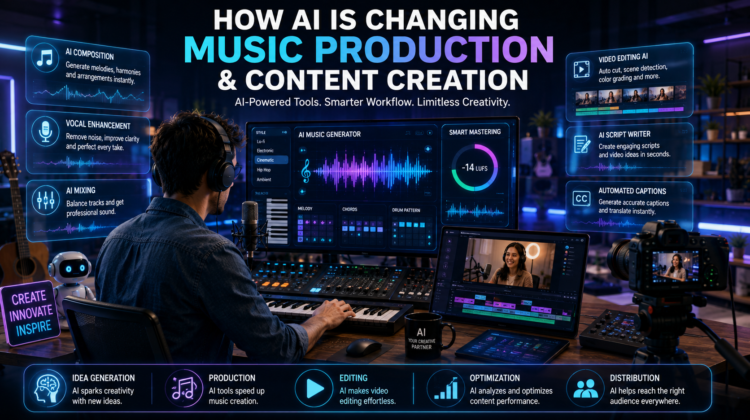
Just a few years ago, creating professional-quality music or digital content required expensive equipment, specialized software, and years of technical experience. Today, artificial intelligence is transforming that reality. In 2026, musicians, video creators, podcasters, marketers, and content creators are using AI to produce high-quality work faster, more efficiently, and with greater creative freedom than ever before.
AI is no longer simply automating repetitive tasks. It has become a creative collaborator that helps generate melodies, enhance vocals, edit videos, write scripts, remove background noise, design visuals, and even personalize content for different audiences. While some people worry that AI will replace human creativity, the opposite is proving true. The most successful creators are using AI as a powerful assistant rather than a replacement.
From independent artists recording music at home to major production studios creating blockbuster campaigns, artificial intelligence is reshaping every stage of the creative process. It is making professional production accessible to millions of creators around the world while opening entirely new possibilities for innovation.
Whether you’re a musician, YouTuber, filmmaker, podcaster, social media creator, or digital entrepreneur, understanding how AI is changing music production and content creation is essential for staying competitive in today’s creative economy.
1. AI Makes Music Production Faster and More Accessible
Producing music once required expensive recording studios, professional engineers, and complex editing software.
Today, AI-powered music production tools help creators generate melodies, suggest chord progressions, separate instruments, enhance audio quality, and automate mixing and mastering.
Independent musicians can now create studio-quality tracks using affordable software that analyzes recordings and applies professional enhancements automatically.
This dramatically lowers the barriers to entry for aspiring artists while allowing experienced producers to work more efficiently.
Creativity Without Technical Barriers
AI removes many technical obstacles, allowing musicians to focus more on songwriting, emotion, and artistic expression.
2. AI Is Transforming Songwriting and Composition
One of the most exciting developments in 2026 is AI-assisted songwriting.
Modern AI tools can generate lyric ideas, compose melodies, recommend harmonies, suggest rhythms, and even create instrumental arrangements based on specific musical styles.
Rather than replacing songwriters, these systems act as creative partners that help overcome writer’s block and inspire fresh ideas.
Many musicians use AI to explore different genres, experiment with unique sounds, and rapidly prototype new compositions before refining them with their own artistic vision.
The result is faster creative experimentation without sacrificing originality.
3. Smarter Audio Editing Improves Production Quality
Editing audio has traditionally been one of the most time-consuming parts of music production.
Artificial intelligence now automates many editing tasks, including removing background noise, correcting pitch, balancing volume levels, detecting unwanted sounds, reducing echoes, and enhancing vocal clarity.
Podcasters, musicians, audiobook producers, and video creators benefit from cleaner recordings without requiring advanced technical knowledge.
AI-powered editing also significantly reduces production time while improving overall sound quality.
4. AI Is Revolutionizing Video Content Creation
Video continues to dominate digital content across social media, marketing, education, and entertainment.
AI now assists creators by automatically editing footage, generating subtitles, identifying highlights, removing silence, enhancing video quality, improving lighting, and creating multilingual voiceovers.
Content creators can publish professional videos much faster while maintaining high production standards.
Faster Production, Greater Consistency
Businesses and influencers increasingly rely on AI to produce regular video content without dramatically expanding production teams.
5. Personalized Content Is Becoming the New Standard
Artificial intelligence enables creators to deliver personalized experiences for different audiences.
Streaming platforms recommend music based on listening habits, while marketing teams create customized advertisements tailored to specific customer interests.
Content creators can adapt messaging, visuals, language, and recommendations according to audience behavior.
This personalization increases engagement because viewers receive content that feels more relevant to their individual preferences.
As personalization technology improves, audience expectations continue rising.
6. AI Supports Social Media Content Creation
Maintaining an active online presence requires consistent content production.
AI helps creators generate captions, optimize posting schedules, recommend hashtags, edit short-form videos, design thumbnails, create promotional graphics, and analyze audience engagement.
Instead of spending hours preparing every post manually, creators can focus on storytelling, community building, and creative strategy.
This efficiency is particularly valuable for independent creators managing multiple platforms simultaneously.
7. AI Improves Podcast Production
Podcasting has become one of the fastest-growing content formats.
AI simplifies podcast production by automatically transcribing episodes, generating summaries, removing filler words, balancing audio, creating show notes, translating conversations, and identifying key discussion highlights.
These features help podcasters produce professional content with significantly less editing time.
Listeners benefit from higher-quality audio while creators can publish episodes more consistently.
8. AI Is Changing Marketing for Creative Professionals
Creating exceptional content is only part of building a successful creative career.
Artists, musicians, filmmakers, and influencers also need effective marketing strategies.
AI-powered marketing platforms analyze audience behavior, predict engagement trends, optimize advertising campaigns, personalize email marketing, recommend publishing schedules, and improve search engine optimization.
These insights allow creators to reach larger audiences while maximizing limited marketing budgets.
Creative success increasingly depends on combining artistic talent with intelligent marketing.
9. Collaboration Between Humans and AI Is Driving Innovation
Some people initially feared AI would replace creative professionals.
Instead, the industry is increasingly embracing collaboration.
Human creators provide emotion, storytelling, originality, cultural understanding, and artistic vision, while AI contributes speed, efficiency, data analysis, and technical assistance.
The strongest creative projects emerge when technology enhances rather than replaces human imagination.
This collaborative model is becoming the foundation of modern music production and digital content creation.
10. Ethical and Copyright Considerations Continue Evolving
As AI-generated music and creative content become more common, important legal and ethical questions continue emerging.
Creators increasingly consider issues such as intellectual property, licensing, transparency, artist rights, training data, and ownership of AI-assisted works.
Businesses and creators are adopting responsible AI practices by respecting copyright, disclosing AI-generated material when appropriate, and ensuring original creators receive proper recognition.
These conversations will continue shaping the creative industry throughout the coming years.
Why Human Creativity Will Always Matter
Artificial intelligence can generate ideas, automate production, and accelerate workflows.
However, it cannot fully replace human emotion, lived experiences, personal storytelling, cultural understanding, or authentic artistic expression.
Listeners connect with songs because they reflect genuine emotions.
Audiences engage with videos because creators share real experiences.
Brands succeed because they build trust through authentic communication.
AI enhances creativity, but human imagination remains the foundation of meaningful content.
The future belongs to creators who successfully combine technology with originality.
Looking Ahead: The Future of AI in Creative Industries
Artificial intelligence is fundamentally changing how music and digital content are created, distributed, and experienced. As technology continues advancing throughout the coming decade, AI will become even more integrated into songwriting, video production, animation, gaming, podcasting, filmmaking, marketing, and immersive digital experiences.
Rather than replacing creative professionals, AI is expanding creative possibilities while making professional-quality production accessible to millions of people worldwide.
For musicians, content creators, businesses, and entrepreneurs, embracing AI represents an opportunity to work faster, reach larger audiences, reduce production costs, and unlock entirely new forms of artistic expression.
In 2026, the creators who thrive will be those who view AI not as a competitor, but as one of the most powerful creative tools ever developed.
Leave a Reply