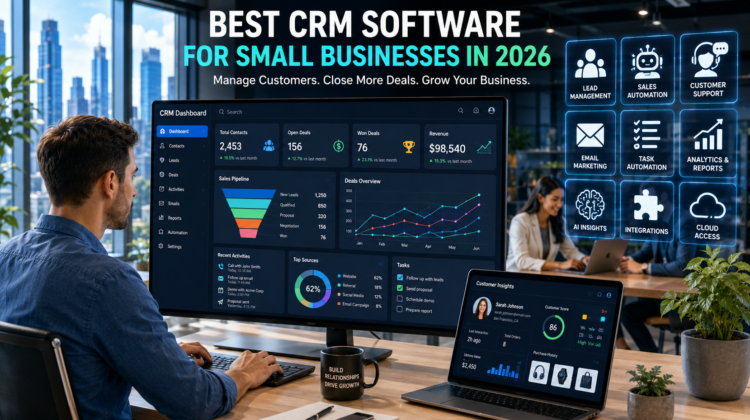
Running a small business often feels like juggling dozens of responsibilities at once. One moment you’re responding to customer inquiries, the next you’re following up on sales leads, sending invoices, planning marketing campaigns, and trying to keep existing customers happy. As your business grows, managing customer relationships manually becomes increasingly difficult, and that’s where Customer Relationship Management (CRM) software makes a real difference.
In 2026, CRM software has evolved far beyond being a simple contact database. Modern CRM platforms now combine artificial intelligence, automation, predictive analytics, workflow management, customer support, sales tracking, and marketing automation into one powerful system. They help businesses organize customer information, close more sales, improve customer service, and make smarter business decisions.
The good news is that today’s CRM solutions are no longer designed exclusively for large corporations. Small businesses now have access to affordable, cloud-based CRM platforms that are easy to implement, scalable, and packed with enterprise-level features.
Choosing the right CRM can transform the way your business operates. Whether you’re launching a startup, managing an online store, or running a growing service company, here are the best CRM software solutions every small business should consider in 2026.
1. HubSpot CRM – Best Overall Free CRM
HubSpot CRM continues to be one of the most popular choices for small businesses thanks to its generous free plan and user-friendly interface.
It allows businesses to organize contacts, track deals, automate follow-ups, manage customer interactions, schedule meetings, and monitor sales performance without requiring advanced technical knowledge.
Its AI-powered features assist with email writing, sales forecasting, customer insights, and workflow automation, making it an excellent solution for growing businesses.
Why Small Businesses Love It
HubSpot offers an excellent balance between simplicity and powerful functionality, allowing businesses to expand without changing CRM platforms later.
2. Salesforce Starter Suite – Best for Growing Companies
Salesforce remains one of the world’s leading CRM providers, and its Starter Suite makes enterprise-level capabilities more accessible to small businesses.
The platform combines customer management, AI-powered sales insights, marketing automation, reporting, and customer service tools in a single ecosystem.
As businesses expand, Salesforce scales alongside them, supporting increasingly complex sales processes and customer relationships.
Its powerful AI capabilities help sales teams prioritize leads and identify the best growth opportunities.
3. Zoho CRM – Best Value for Small Businesses
Zoho CRM has become a favorite among startups and small companies because it combines affordability with impressive functionality.
Businesses can automate sales workflows, manage customer communications, analyze performance, generate reports, and integrate with numerous business applications.
Its built-in AI assistant provides intelligent recommendations that improve productivity and sales efficiency.
Zoho’s flexible pricing makes it especially attractive for budget-conscious entrepreneurs.
4. Pipedrive – Best for Sales Teams
Pipedrive focuses on helping businesses close more deals through visual sales pipeline management.
Instead of overwhelming users with unnecessary complexity, the platform provides intuitive tools for tracking leads, monitoring sales activities, forecasting revenue, and automating follow-up communications.
Sales representatives appreciate its clean interface, while managers benefit from detailed reporting and performance analytics.
Keeping Sales Organized
Businesses that rely heavily on outbound sales often find Pipedrive particularly effective because it keeps every opportunity visible and easy to manage.
5. Freshsales – Best AI-Powered CRM
Freshsales combines CRM functionality with artificial intelligence to improve customer engagement and sales performance.
Its AI capabilities analyze customer behavior, score leads, recommend next actions, predict deal outcomes, and automate repetitive sales tasks.
Built-in communication features allow businesses to manage emails, phone calls, and customer conversations from one platform.
This integrated approach improves productivity while simplifying customer relationship management.
6. Monday CRM – Best for Workflow Management
Monday CRM blends traditional customer management with flexible project management capabilities.
Businesses can customize workflows, automate routine tasks, manage customer communications, monitor project progress, and collaborate across departments using one platform.
Its visual dashboards make information easy to understand while supporting business growth through improved operational efficiency.
Organizations seeking flexibility often appreciate Monday CRM’s customizable approach.
7. Microsoft Dynamics 365 – Best for Microsoft Users
Businesses already using Microsoft products often benefit from Microsoft Dynamics 365.
The platform integrates seamlessly with Outlook, Teams, Excel, Power BI, and other Microsoft services while providing advanced customer management capabilities.
Artificial intelligence enhances customer insights, sales forecasting, and operational planning.
Although more powerful than many entry-level CRMs, it remains a strong choice for businesses planning significant future expansion.
8. Insightly – Best for Relationship Management
Insightly combines CRM functionality with project management features, making it particularly useful for service-based businesses.
Companies can manage customer relationships, monitor ongoing projects, automate workflows, and generate business reports from one centralized platform.
The system supports collaboration across sales, marketing, and customer service teams while maintaining detailed customer histories.
This holistic approach improves communication throughout the organization.
9. Nimble – Best for Social Relationship Building
Nimble focuses on relationship management by integrating customer information from email, calendars, and social media platforms.
Businesses gain a comprehensive view of customer interactions, helping sales teams build stronger long-term relationships.
The platform simplifies contact management while automatically updating customer profiles using publicly available business information.
Relationship-focused businesses often appreciate this unique capability.
10. Close CRM – Best for Inside Sales
Close CRM is designed specifically for businesses with active sales teams.
The platform combines calling, email automation, SMS messaging, sales reporting, and pipeline management into one streamlined interface.
Its automation features eliminate repetitive administrative work, allowing sales professionals to spend more time speaking with prospects and closing deals.
For businesses focused on high-volume sales, Close CRM offers an efficient and productivity-driven solution.
How to Choose the Right CRM for Your Business
Selecting CRM software isn’t simply about choosing the platform with the most features.
The best CRM is the one that aligns with your business size, budget, sales process, customer service requirements, team structure, and long-term growth goals.
Businesses should consider ease of use, automation capabilities, AI functionality, reporting tools, scalability, integration options, customer support, and overall return on investment before making a decision.
Many providers offer free trials, allowing businesses to evaluate software before committing to long-term subscriptions.
Taking time to test different platforms often leads to better long-term results.
Why AI Is Changing CRM Forever
Artificial intelligence is transforming customer relationship management in remarkable ways.
Instead of simply storing customer information, modern CRM systems now predict customer behavior, recommend personalized communications, identify sales opportunities, automate repetitive workflows, and provide strategic business insights.
These intelligent capabilities allow even small businesses to deliver customer experiences that previously required large enterprise budgets.
As AI continues evolving throughout 2026 and beyond, CRM platforms will become even more proactive, helping businesses anticipate customer needs before they arise.
Looking Ahead: CRM as the Foundation of Business Growth
Customer relationships remain one of the most valuable assets any business can build. Regardless of industry, organizations that understand their customers, communicate effectively, and deliver exceptional service consistently outperform competitors.
Modern CRM software has become much more than a sales tool. It now serves as the central hub connecting marketing, customer support, analytics, automation, and business intelligence.
For small businesses, investing in the right CRM is an investment in sustainable growth. As artificial intelligence continues enhancing customer relationship management, businesses that embrace these technologies today will be better prepared to compete, scale, and succeed in tomorrow’s increasingly digital marketplace.
Leave a Reply